

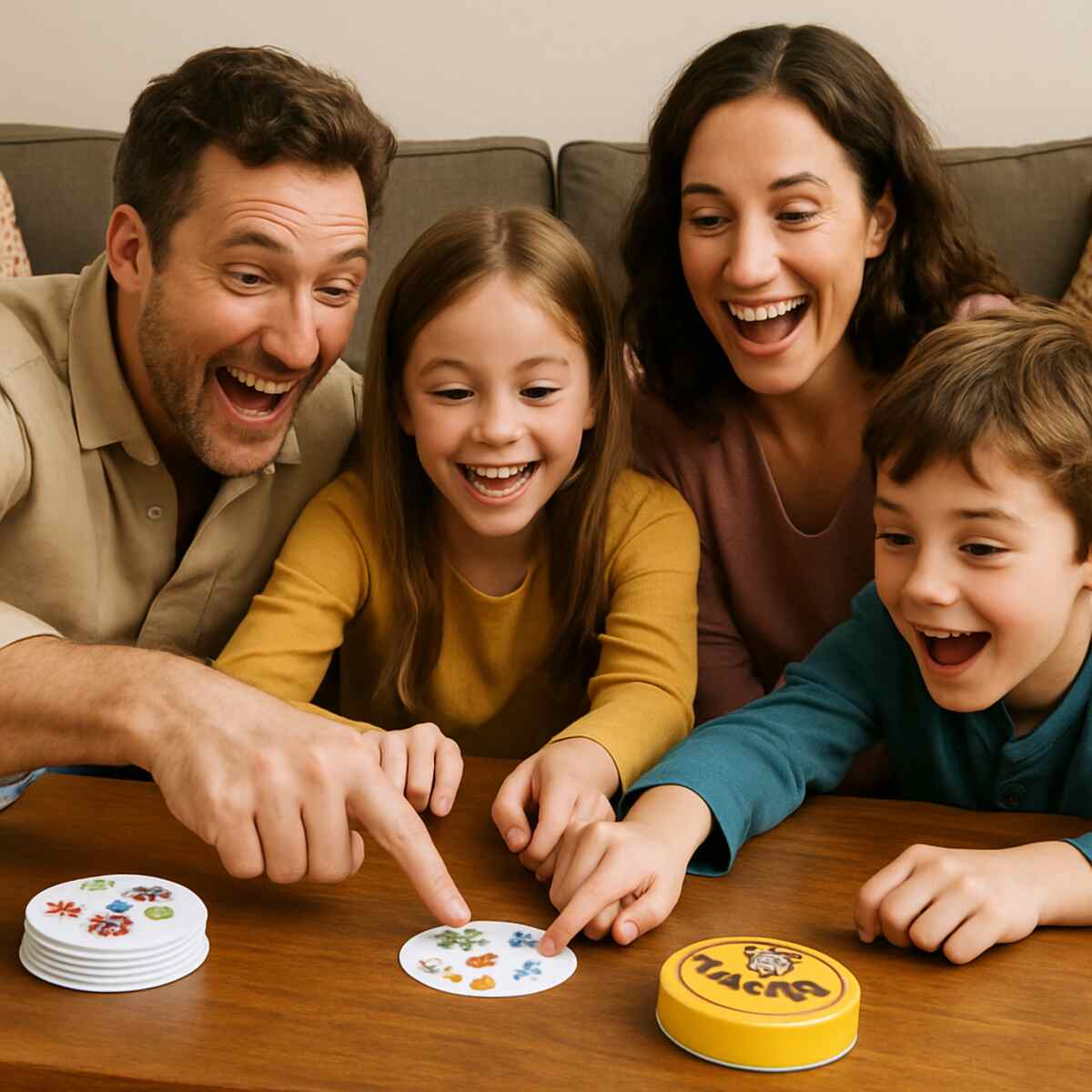

Have you ever stared intently at two seemingly distinct circular cards, absolutely convinced that there is no matching symbol between them, only to have your opponent suddenly shout, “Igloo!” before snatching the card away? Welcome to the thrilling, fast-paced, and occasionally mind-boggling universe of the spot it game. Get the Best information about slot online.
At first glance, it looks like mere child’s play. A small tin, a deck of cards, and a bunch of colorful, cartoonish symbols. Yet, beneath this colorful exterior lies a fiercely competitive tabletop experience that tests your reflexes, visual processing speed, and grace under pressure. Whether you know it by its North American name or its European moniker, Dobble has taken the world of tabletop gaming by storm.
In this comprehensive guide, we will dive deep into everything you need to know about this modern classic. We will explore the underlying geometry that makes the game possible, break down the official Spot It! rules, offer advanced strategies for mastering speed-matching, and examine why it stands as one of the best travel games for families.
Whether you are a casual player looking to beat your kids, a teacher utilizing the educational benefits of matching games, or a tabletop enthusiast wanting to dominate your next game night, this guide will equip you with the knowledge to spot the match before anyone else even blinks.
What is the Spot It Game?
The spot it game is a revolutionary matching card game created by Denis Blanchot, Jacques Cottereau, and PlayFactory, first published by Blue Orange Games in 2009. The premise is deceptively simple: each card features a variety of different symbols, and any two cards in the deck share exactly one matching symbol.
Your goal in almost every variation of the game is to be the first person to find and name the matching symbol.
Unlike traditional card games that rely on standard rectangular decks, this game is famous for its compact circular tin cards. The round cards eliminate the traditional “top” and “bottom” orientation, allowing symbols to be viewed from any angle. This design choice is not just aesthetic; it fundamentally changes how your brain processes the images, forcing you to decouple the card’s orientation from the symbol’s shape.
It is widely considered the gold standard among visual perception card games, spawning dozens of themed editions, from Harry Potter and Marvel to NHL and camping versions.
The Genius Behind the Game: The Mathematical Principle of Projective Planes
Before we jump into the rules and strategies, it is essential to appreciate the sheer genius of the deckis construction. Have you ever wondered how it is mathematically possible that any two cards you pull from the deck will always have exactly one matching symbol?
It feels like magic, but it is actually built on a complex mathematical concept known as finite geometry, specifically the mathematical principle of projective planes.
How the Math Works
To understand the math without getting a PhD in geometry, imagine a set of intersecting lines. In a standard projective plane, every pair of lines intersects at exactly one point, and every pair of points can be connected by exactly one line.
In the development of this game, the creator utilized the Fano plane—a finite projective plane—and scaled it up to what mathematicians call a projective plane of order 7.
- The “Points” are the Symbols: There are 57 different symbols used in the standard game.
- The “Lines” are the Cards: There are 55 cards in the standard deck (though mathematically, a perfect order 7 plane would have 57 cards, manufacturers often drop two for printing convenience).
- The Rule of Intersection: Because every two lines intersect at exactly one point, every two cards must share exactly one symbol.
The Illusion of Size
To make the game challenging, the designers didn’t just place identical symbols on every card. They utilized symbol matching mechanics that alter the size and positioning of the symbols. On one card, the “Snowman” might be the largest symbol taking up the center, while on the matching card, the “Snowman” might be tiny and tucked away near the edge.
Because the human brain naturally expects matching objects to be the same size, this simple graphical manipulation severely disrupts our pattern recognition speed, creating the game’s signature hesitation and panic.
Understanding the Core Spot It Rules
The beauty of the game lies in its accessibility. You can teach a five-year-old the fundamental spot it rules in about thirty seconds. However, the rulebook isn’t just one single game; it is a collection of mini-games.
The Universal Rule
No matter which specific variation you are playing, the universal rule remains constant: You must identify the matching symbol between two cards, point it out, and call its name out loud.
You cannot simply point. You cannot grunt. You must verbalize the word. If the symbol is a piece of cheese, you must yell “Cheese!” This forces a connection between your visual processing center and your language center, adding an extra layer of cognitive load.
Handling Ties
Because this falls into the category of fast-paced reaction games, ties are incredibly common. If two players shout the matching symbol at the exact same time, the player who physically takes (or places) the card first wins the tie. If it’s a dead heat in both voice and hands, players generally agree to a draw on that specific card and move on to the next.
Deep Dive: How to Play Dobble Rules (The 5 Mini-Games)
Depending on where you purchased your game, you might be playing Dobble. Do not be confused; Spot It and Dobble are the exact same game, just distributed under different names in different regions (Dobble in Europe and the UK, Spot It in North America). Therefore, the rules for playing Dobble are identical to those of the North American spot-it game.
The official rulebook outlines five distinct mini-games. To truly master the game, you need to understand the mechanics and objectives of all five.
Mini-Game 1: The Tower (or Tower of Babel)
This is the most common way to play and the best introduction for beginners.
- The Setup: Shuffle the deck. Deal one card face down to each player. Place the remaining deck face up in the center of the table.
- The Objective: To collect the most cards.
- How to Play: On the count of three, all players flip their cards face up. Players immediately scan their card and the top card of the center deck. If you find the match, shout the symbol’s name and grab the center card, placing it face up on top of your own card.
- The Catch: As soon as a player grabs the center card, a new center card is revealed, and everyone must now match their top card to the new center card. The game ends when the center deck is empty.
Mini-Game 2: The Well
This is the exact inverse of The Tower.
- The Setup: Place one card face up in the center of the table. Deal all the remaining cards evenly among the players, keeping them face down in a draw pile in front of each player.
- The Objective: To be the first player to get rid of all your cards.
- How to Play: On the count of three, players flip their personal decks face up. You must match the top card of your deck with the card in the center. When you find the match, shout it, and place your card on top of the center card.
- The Catch: The center card is constantly changing as players throw their cards onto the pile. You must be incredibly fast to drop your card before someone else changes the target.
Mini-Game 3: Hot Potato
This variation is played in multiple short rounds and induces maximum panic.
- The Setup: Deal one card face down to each player. Keep the rest of the deck aside.
- The Objective: To have the fewest cards at the end of the game.
- How to Play: Players hold their single card face down in their palm. On “go,” players flip their cards face up, keeping them flat in their palms. You must find a match between your card and any other player’s card. If you find a match, shout the symbol and place your card face up on top of the other player’s card.
- The Catch: That player now holds two cards. They must now use the new top card to find a match with the remaining players. The round ends when one unlucky player is holding all the cards. Play proceeds for a set number of rounds (usually 5 or 10).
Mini-Game 4: The Poisoned Gift
This game requires a devious mindset, as you are actively trying to sabotage your opponents.
- The Setup: Deal one card face down to each player. Place the remaining deck face up in the center.
- The Objective: To have the fewest cards when the center deck runs out.
- How to Play: Players flip their cards. Instead of matching your card to the center, you must find a match between the center card and an opponent’s card. When you spot it, shout the symbol, take the center card, and place it on top of your opponent’s deck.
- The Catch: You are constantly scanning other people’s cards instead of your own. The changing center card resets the board every few seconds.
Mini-Game 5: Triplet
This variation feels completely different and leans heavily into pure multiplayer observation challenges.
- The Setup: Place all cards face down in a single deck. Draw the top nine cards and arrange them face up on the table in a 3×3 grid.
- The Objective: To collect the most cards by finding matching sets of three.
- How to Play: All players look at the grid simultaneously. You are looking for a single symbol that appears on three different cards in the grid. When you find it, shout the symbol, point to the three cards, and claim them. Replace the three missing cards with new ones from the deck.
- The Catch: The game ends when fewer than nine cards remain and no more sets of three can be made. This requires a much wider visual focus than the other mini-games.
Mastering Speed Matching Techniques: Advanced Gameplay Strategies
Understanding the rules is one thing; dominating your friends and family is another entirely. If you want to stop losing to your ten-year-old nephew, you need to start mastering speed matching techniques.
Because this is a game of visual processing, physical reflexes, and verbal recall, you can train your brain to perform better using specific strategies.
1. The “Anchor Symbol” Technique
When playing “The Tower,” the center card changes every time someone claims it, but your personal card only changes when you win. Therefore, you should never rescan your own card from scratch. Instead, memorize 3 or 4 of the largest, most distinct symbols on your card. Keep repeating them in your head (e.g., “Tree, Ghost, Dragon”). When the new center card is revealed, you only need to scan the center card for those three specific symbols. This drastically cuts down your visual processing time.
2. Overcoming the Size Illusion
As mentioned earlier, the game’s designers manipulate the size of the symbols to trick your brain. A massive anchor on one card might be microscopic on another. To combat this, practice looking at the shape and color rather than the overall mass of the object. Squinting slightly can help blur the details and make the brightly coloured shapes pop, making it easier to match a giant green dinosaur to a tiny green dinosaur.
3. Peripheral Vision Scanning
Amateur players look at their card, then look at the center card, back and forth, moving their neck or their eyes drastically. This “saccadic eye movement” takes milliseconds—time you don’t have. To master the game, hold your card as close to the center card as physically possible. Soften your focus so you are looking at the space between the two cards, utilizing your peripheral vision to take in both cards simultaneously.
4. Verbal Priming
Sometimes you see the match but your brain completely forgets the word for it. (Is it a water drop? A tear? Rain?) The official rules usually state that any reasonable name for the symbol is acceptable as long as it’s understood, but hesitation kills your chances. Before the game starts, take two minutes to look through the deck and verbally agree on what to call the weird symbols. “This red blob is ‘Paint’, this green leafy thing is ‘Clover’.” Priming your brain with the exact vocabulary ensures the word is on the tip of your tongue when the adrenaline hits.
5. Aggressive Hand Placement
In games like The Well and The Poisoned Gift, physical distance matters. Hover your hand near the center pile (without blocking anyone’s view). The moment your brain registers the match, start moving your hand while your mouth forms the word. In fast-paced reaction games, the physical travel time of your arm can be the difference between winning and losing.
The Educational Benefits of Matching Games
While it is marketed primarily as a wildly fun party game, teachers, occupational therapists, and child psychologists have long praised the educational benefits of matching games. Spot It, in particular, is frequently used in classroom settings and therapy sessions.
Visual Discrimination Skills Development
Visual discrimination is the ability to recognize details in visual images. It allows children to identify and recognize the likeness and differences of shapes, forms, colors, and positions of objects, people, and printed materials. Spot It provides intense, gamified visual discrimination skills development. A child must differentiate between a green leaf and a green dinosaur quickly. This exact cognitive skill is fundamental for reading and writing. A child who struggles to distinguish between a lowercase “b” and a lowercase “d” can greatly benefit from the visual exercises in this game.
Enhancing Cognitive Processing Speed
Processing speed is the pace at which you take in information, make sense of it, and begin to respond. The artificial time limit imposed by competing players forces the brain to process visual stimuli rapidly. Over time, playing speed-based games can help improve a child’s ability to quickly retrieve information from their working memory.
Speech and Language Therapy
Because the game requires players to yell out the name of a symbol, speech-language pathologists use it to help children with word-retrieval and expressive-language disorders. The pressure of the game mimics the real-life pressure of fast-paced conversation, helping kids practice finding the right word under stress in a safe, fun environment.
Executive Functioning and Emotional Regulation
Losing a round of Hot Potato is frustrating. Missing a match that was “right there” is agonizing. Playing these types of tabletop games helps children practice emotional regulation, impulse control, and sportsmanship. They learn to manage the adrenaline of a fast-paced environment without resorting to tantrums.
Why Spot It is the Ultimate Portable Entertainment for Kids
In an era dominated by iPads, Nintendo Switches, and smartphones, parents are constantly on the hunt for engaging alternatives. If you are looking for top-tier portable entertainment for kids, this game is virtually unmatched.
The Perfect Form Factor
The brilliant packaging of the game—its compact circular tin cards—makes it incredibly durable and easy to transport. Unlike cardboard boxes that get crushed in backpacks or tear at the corners, the metal tin can survive being tossed into a purse, jammed into a tightly packed suitcase, or dropped on the floor of a minivan.
Screen-Free Activities for Road Trips
Long car rides often devolve into zombie-like staring at screens. Spot It provides one of the best screen-free activities for road trips. Because the game requires no board, no dice, and no complex setup, kids can easily play it on their laps in the backseat. You can play a modified version of “The Tower” using the middle console as the center pile. The quick rounds mean siblings can play for ten minutes, stop for a snack break, and pick right back up without having to remember whose turn it is or keep track of complex scores.
Best Travel Games for Families on Flights and in Restaurants
When flying, tray table space is at a premium. Massive board games are out of the question. Spot It requires roughly an 8-inch-diameter table space to play effectively. This minimal footprint makes it one of the best travel games for families navigating airport layovers or waiting for food at a restaurant.
It completely bridges the age gap. A seven-year-old genuinely has the same (if not better) visual processing speed as a forty-year-old. Unlike trivia games or heavy strategy games where adults have to “let the kids win,” parents can play this game at full capacity, and the kids will still regularly wipe the floor with them.
Beyond the Living Room: Waterproof Camping Game Options
Standard playing cards and the great outdoors do not mix. A sudden gust of wind, a spilled canteen of water, or a damp picnic table can ruin a standard deck of cardboard cards in seconds.
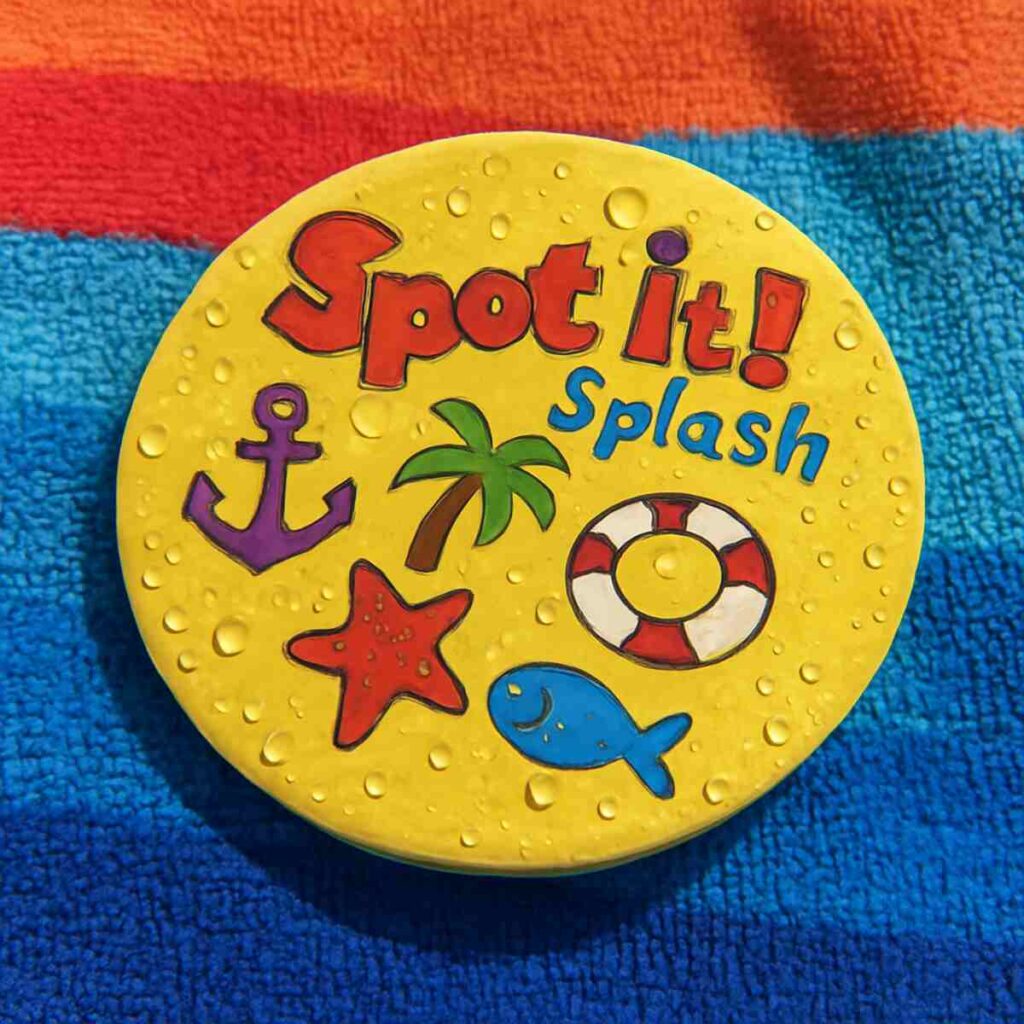
Recognizing that families were taking their games into the wild, the publishers released Spot It! Splash (sometimes branded as Spot It! Waterproof or Spot It! Camping).
This version uses the same brilliant symbol matching mechanics but prints the symbols on durable, plastic-coated cards. This evolution catapulted the game to the top of the list for waterproof camping game options.
Where to Play Spot It Splash:
- At the Pool or Beach: The cards are literally waterproof. You can play them on a wet towel or a pool float. If they get covered in sand, you simply rinse them off in the water.
- On a Camping Trip: Play on a dew-covered picnic table in the morning while waiting for the campfire to boil the coffee.
- At the Pub or Brewery: For adults, the waterproof version is highly recommended for pub settings. A spilled pint of beer will permanently warp a standard deck, but the Splash edition simply wipes clean with a napkin.
The Splash edition also swaps out the standard symbols for beach and camping-themed icons (like sunglasses, flip-flops, and campfires), adding a thematic flair to your outdoor adventures.
Game Clash: Dobble vs Blink Comparison
When discussing fast-paced matching card games, another title often comes up: Blink. Often marketed as “the world’s fastest game,” Blink shares a lot of DNA with our beloved circular tin game. If you are building a collection of family games, you might wonder which one is better. Let’s dive into a Dobble vs Blink comparison.
Mechanics of Blink
In Blink, cards feature shapes (stars, triangles, moons) in different quantities (1 to 5) and different colors. Players try to empty their hands by matching the card they want to play to the top card of the center pile based on one of three criteria: shape, count, or color.
The Key Differences
- Cognitive Flexibility vs. Visual Processing:
- Blink is an exercise in cognitive flexibility. Your brain must constantly switch the “rule” it is using. You might play a card because it matches the color (Red), and then immediately play the next card because it matches the shape (Triangle). This requires your brain to shift gears rapidly.
- Dobble/Spot It is an exercise in pure visual processing and pattern recognition. The rule never changes: find the identical symbol. The challenge comes strictly from the visual clutter and size manipulation.
- Number of Players:
- Blink is almost exclusively a 2-player duel. While there are rules for adding more, it shines in a head-to-head battle.
- Spot It handles multiplayer observation challenges flawlessly. You can play with up to 8 players without the game losing any of its frantic energy or structural integrity.
- Language Requirement:
- Blink requires no speaking. It is a silent, rapid-fire physical matching game.
- Spot It requires verbalization. Calling out the symbol is mandatory, which, as discussed, utilizes different parts of the brain and creates a louder, more raucous party atmosphere.
The Verdict: If you want a silent, intense, 2-player brain-burner, Blink is excellent. However, if you are looking for a party game that accommodates more players, bridges age gaps effortlessly, and generates loud laughter and table-slapping excitement, Spot It takes the crown.
Navigating the World of Visual Perception Card Games
Spot It essentially created a new sub-genre of tabletop gaming. Since its release, the market has exploded with other visual perception card games. While our circular champion remains the king, understanding the broader landscape can help you appreciate why its specific mechanics are so finely tuned.
Similar Games in the Genre
- Ghost Blitz (Bausack): Instead of cards, this game uses physical wooden objects (a white ghost, a green bottle, a gray mouse, a red chair, a blue book). A card is flipped, and players must grab the correct object based on a set of visual logic rules. It combines the visual processing of Spot It with the physical grabbing mechanic of Jungle Speed.
- Jungle Speed: Players flip cards, and if the abstract symbols on two cards match, those players must duel to grab a central wooden totem. The symbols are incredibly similar (varying only by slight line thickness or a single curve), testing micro-visual discrimination.
- Set: A more analytical visual game where players find three cards that are either all the same or all different across four features (color, shape, number, shading). It is much slower and more mathematical than Spot It, appealing to puzzle lovers.
What makes Spot It stand out among these fast-paced reaction games is its universality. Ghost Blitz requires deductive logic. Jungle Speed can lead to literal scratched hands and broken nails. Set requires quiet concentration. Spot It manages to hit the exact sweet spot of being energetic, universally accessible, and purely intuitive.
Expanding Your Collection: The Best Themed Editions
Once you have mastered the original deck, you might find that your brain has inadvertently memorized certain symbol pairings. To keep your reflexes sharp and your symbol matching mechanics fresh, the publishers have released dozens of variations.
Here are a few notable editions that provide unique twists:
- Spot It! Animals: Perfect for younger kids. Instead of random objects like igloos and yin-yangs, every symbol is an animal. This is fantastic for toddlers who are just learning their animal vocabulary.
- Spot It! Marvel / Star Wars / Harry Potter: These licensed editions swap the classic symbols for pop culture icons (Iron Man’s helmet, a lightsaber, the Golden Snitch). They are incredible gifts for fans and actually increase the difficulty, as themed symbols often share similar color palettes (e.g., lots of metallic colors in Star Wars), making them harder to distinguish quickly.
- Spot It! Alphabet / Numbers: Geared directly toward early childhood education. Teachers use these to gamify letter and number recognition.
How to Host a Spot It Tournament at Home or School
Because the rounds are so fast and the rules are so simple, hosting a tournament is a fantastic way to entertain a large group of people at a family reunion, birthday party, or in a classroom.
Step 1: Establish the Format
For a tournament, you want a format that relies purely on speed and minimizes luck. Mini-Game 1: The Tower is the best official mode for tournament play. It is easy to track who wins (the one with the tallest stack of cards).
Step 2: The Bracket System
If you have 16 players, set up four tables with four players each.
- Round 1: Play one full game of The Tower at each table. The top two players with the most cards from each table advance.
- Semi-Finals: You now have 8 players. Make two tables of four. Play another round of The Tower. The top two from each table advance.
- The Finals: The final four players battle it out in a best-of-three series of The Tower to determine the ultimate champion.
Step 3: Tournament Specific Rules
To avoid arguments, establish strict tournament rules before you begin:
- The “Hand Hover” Rule: Players must keep their hands off the table until they have verbally shouted the match. No pre-grabbing.
- The “Tie-Breaker” Rule: In the event of a simultaneous shout and grab, the adjudicator (a non-playing referee) decides who was first. If the referee cannot decide, the card is placed at the bottom of the centre deck, and a new card is revealed.
- The “Wrong Call” Penalty: If a player shouts a word in a panic that does not match, they must sit out the next card reveal, giving their opponents a free shot.
Frequently Asked Questions (FAQs)
How many cards are actually in the Spot It game tin?
The standard tin contains 55 cards. While a mathematically perfect projective plane of order 7 would generate 57 cards, printing presses traditionally handle cards in sheets of 55 (similar to a standard poker deck of 52 + jokers + ad cards). Two cards are intentionally left out, which does not break the mathematical rule that any two remaining cards will share a single match!
Can a 4-year-old play?
Yes! However, you might want to modify the spot it game rules slightly. Instead of playing competitively, you can play cooperatively. Draw two cards, lay them flat, and work together to find the match. It’s a great tool for building vocabulary and focus without the stress of the timer.
What do I do if we lose a card?
The brilliant part of the mathematical principle of projective planes is that the game is virtually indestructible. If you lose one, five, or even ten cards under the couch, the game still works perfectly. Any two cards drawn from the remaining deck will still have exactly one matching symbol. You just play a slightly shorter game.
Are Dobble and Spot It identical?
Yes. The cards, the math, and the spot-it rules are 100% identical to the European Dobble how-to-play rules. The only difference is the logo on the back of the cards and the branding on the tin.
Is there a strategy to "Hot Potato" specifically?
Yes! In Hot Potato, you want to get rid of your card as fast as possible. Instead of looking at everyone’s cards, pick one opponent (preferably the one who is currently distracted or looking away) and focus entirely on matching your card to theirs. Once you dump your card on them, you are safe for the round.
Conclusion: Ready, Set, Spot It!
It is incredibly rare for a game to appeal equally to a kindergarten classroom, a family on a cross-country road trip, and a group of competitive adults at a pub. Yet, the spot it game manages to bridge all these gaps with its deceptively simple symbol matching mechanics and brilliant geometric design.
By understanding the deeper spot it game rules and the five distinct mini-games, you elevate the experience from a simple distraction to a dynamic, varied tabletop event. Furthermore, by practicing the advanced techniques outlined in this guide—such as peripheral scanning and anchor symbols—you will find yourself mastering speed matching techniques and dominating game night.
Beyond the competitive fun, we cannot ignore the profound educational benefits of matching games. From improving cognitive processing speed to developing vital visual discrimination skills, this compact tin holds far more value than a typical toy. It is a brain gym disguised as a party game.
Whether you are tossing the compact circular tin cards into your backpack for screen-free activities for road trips, utilizing the waterproof camping game options by the lake, or hosting intense multiplayer observation challenges in your living room, you are guaranteed hours of chaotic, adrenaline-fueled fun.
So, the next time someone challenges you, remember the strategies. Soften your focus, prime your vocabulary, hover your hand, and get ready to yell “Dragon!” before they even know what hit them. Happy spotting!
