


Bet404 betting strategies should start with understanding odds, checking the operator, and setting limits—not searching for guaranteed picks. This article explains how to assess a wager, compare potential returns, avoid misleading systems, and review your decisions. These methods can make your approach more informed, but gambling is not a reliable income source, and good preparation cannot guarantee a profit. Receive the Best information about bet404.
Can you guarantee a win on Bet404?
No. There is no dependable strategy that guarantees you will win on Bet404. Michigan’s gambling regulator advises that, although winning money is possible, coming out ahead over the long run is unlikely. Treat any promise of certain profits as a reason to stop and question the offer, not a reason to increase your stake.
It helps to separate three goals: predicting an outcome, getting a reasonable price, and controlling your spending. A correct prediction can still produce a poor return relative to its risk. A carefully assessed bet can also lose, so judge your decision by the information available beforehand rather than the final score alone.
Start with these expectations:
- Losses are possible on every wager. Never describe a selection as money you can already spend.
- Research has limits. Record what remains unknown instead of filling gaps with confidence.
- Skipping a bet is valid. You do not need a selection for every match or session.
- Your financial obligations come first. Do not build a gambling plan around paying bills or replacing wages.
The practical aim is to make fewer avoidable mistakes. That is a more realistic goal than trying to turn every session into a winning one. Keep that distinction in mind throughout the examples below, which are hypothetical and are not predictions or recommended stakes.
Verify Bet404 before considering a deposit
Bet404’s public homepage lists sports predictions, live betting, poker, and casino categories. Those listings establish what the site advertises, not whether it is authorized where you live or whether particular account protections apply. This article does not verify its licensing, ownership, withdrawal reliability, or eligibility for your location.
Before studying any market, establish exactly which business would hold your money. Do not assume that a familiar name, a search result, or an advertising account identifies the correct operator. Write down the legal business name and exact website domain so you can check them independently.
Check authorization independently
Use the relevant gambling regulator’s official resources rather than relying on a badge displayed by the betting site. For example, Great Britain’s Gambling Commission provides a register searchable by business name, trading name, and domain name. Its records include license status, allowing users to compare an operator’s claims against the regulator’s information.
In the United States, consult your state regulator’s approved-operator information and eligibility requirements. New Jersey’s Division of Gaming Enforcement, for example, publishes sports-wagering information and authorized betting links. An approval in one jurisdiction should not be treated as proof that you may use a service somewhere else.
Use this verification checklist:
- Match the exact domain against the relevant official record.
- Check that the business name matches the name in the account terms.
- Confirm the permitted gambling activity, not just the existence of a license.
- Establish the applicable minimum age and location requirements.
- Identify the complaint process before you need to use it.
- Do not proceed if you cannot resolve a mismatch or understand the terms.
Read account and withdrawal information
Look for written explanations of identity checks, withdrawal methods, possible charges, processing conditions, account closure, and disputes. Save the applicable terms before depositing. If an important condition is unclear, ask a specific written question and retain the response rather than relying on a general reassurance.
Be careful about applying another country’s consumer rules to Bet404. For example, Great Britain’s Gambling Commission imposes specific requirements on its licensees concerning withdrawals and the separation of deposit and bonus balances. Those rules are jurisdiction-specific; they are not evidence that an unverified operator follows the same standards.
Set a spending plan before choosing bets
Decide whether gambling belongs in your entertainment budget at all. If you choose to participate, use only money left after necessities and financial commitments. The Responsible Gambling Council recommends setting money and time limits, avoiding borrowed funds, and never using gambling as a way to pay bills or resolve debt.
A useful spending plan should answer four practical questions: how much you may deposit, how much you may lose, how long you may spend, and what makes you stop. Write the answers down before opening a betting screen. Leave no room for an improvised exception because a particular match looks promising.
Separate different limits
A deposit limit and a loss limit serve different purposes. In your own plan, treat the deposit limit as the maximum new money you will add during a defined period. Treat the loss limit as the maximum reduction you will accept from gambling during that period, including money already in the account.
Also set a time boundary. A dollar amount alone does not tell you when to close the site. The National Council on Problem Gambling recommends determining a budget before betting and setting a time limit rather than allowing sessions to continue indefinitely.
Here is a hypothetical written plan, not a suggested budget:
| Item | Example rule |
|---|---|
| Entertainment allowance | Only a preselected amount that can be lost without affecting necessities |
| Additional deposits | None after the period’s allowance is used |
| Individual stake | A small fixed amount chosen beforehand |
| Session length | A defined end time, regardless of results |
| Stop condition | Reaching any limit or feeling pressure to recover money |
Choose amounts and boundaries that fit your circumstances. If no amount feels genuinely disposable, the appropriate allowance is zero.
Keep stake sizes independent of emotion
For a simple plan, consider using the same small stake rather than changing it after every result. The purpose is consistency, not improved prediction. If your hypothetical fixed stake is two units, a loss should not automatically turn the next wager into four or eight units.
Count unsettled bets before adding another one. Five pending wagers of two units each represent ten units already at risk. Decide whether you are comfortable losing the full outstanding amount, not merely whether the next individual stake looks small.
How do betting odds affect your chances of profit?
Betting odds determine the return on a successful wager and the win rate needed to break even at that price. They do not establish the true probability of the outcome. Understanding that difference helps you avoid confusing a likely winner with a reasonably priced bet. Smarkets’ educational material explains the relationship between odds, probability, and payouts.
The easiest starting point is decimal odds. For a standard winning cash wager, multiply the stake by the decimal price to calculate the total return, including the original stake. Subtract the stake to find the profit; do not count the entire return as money earned.
Calculate the return first
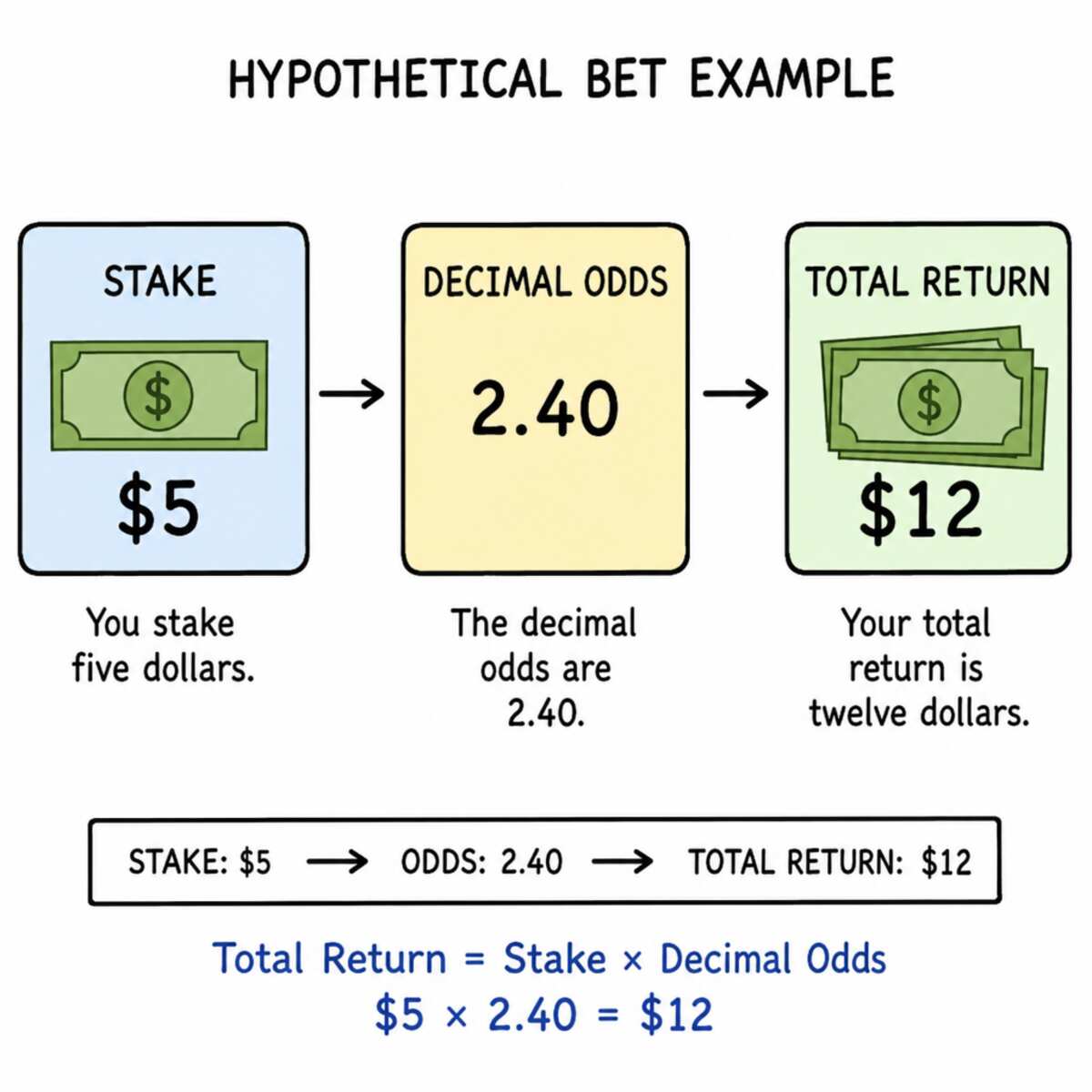
Suppose a hypothetical wager has decimal odds of 2.40 and a stake of $5:
- Total return if successful: $5 × 2.40 = $12.
- Profit if successful: $12 − $5 = $7.
- Loss if unsuccessful: $5, assuming a standard cash bet with no refund provision.
These numbers describe the payment structure, not how likely the selection is to win. They also exclude any charges or special settlement conditions. Always read the actual market rules before applying a simple calculation.
For decimal odds, the break-even percentage is 100 ÷ decimal odds. The following examples use that calculation and assume standard win-or-lose settlement without extra costs.
| Decimal odds | Break-even win rate | Profit on a successful $5 stake |
|---|---|---|
| 1.50 | About 66.7% | $2.50 |
| 2.00 | 50% | $5.00 |
| 2.50 | 40% | $7.50 |
| 4.00 | 25% | $15.00 |
A lower price offers a smaller reward for a successful prediction. It is not a promise of safety. Before accepting any price, explain to yourself what must happen and what you stand to lose.
Recognize the bookmaker’s margin
Sportsbooks can build a margin into their prices. One way to see this is to convert every mutually exclusive outcome in a complete market into its implied percentage and add the percentages together. A total above 100% is commonly called the overround.
Consider a hypothetical two-outcome event with each side priced at 1.90:
- Divide 100 by 1.90 to get approximately 52.63%.
- Repeat for the other outcome.
- Add the two percentages to get approximately 105.26%.
The amount above 100% is about 5.26 percentage points. That calculation does not mean every bettor loses exactly 5.26% of every stake. It shows that the displayed prices do not form a margin-free probability estimate.
When comparing prices, compare identical selections under identical settlement rules. A higher decimal price means a higher return for the same successful cash stake, but a different overtime rule or market definition can make two apparently similar wagers meaningfully different. Do not sacrifice clarity just to obtain a larger number.
Assess value without pretending to know the true probability
A value-based assessment compares your estimated probability with the probability needed to break even at the available odds. The difficult part is not doing the division. It is producing an estimate that is better supported than the market price, a limitation acknowledged in Smarkets’ explanation of value betting.
Use a hypothetical example to see why that matters. Imagine a wager at decimal odds of 2.00. You believe it has a 55% chance of winning, and you are considering a $10 stake.
Under those assumptions, the expected result is:
- A 55% chance of earning $10 profit.
- A 45% chance of losing $10.
- An expected result of (0.55 × $10) − (0.45 × $10) = $1 per wager.
That $1 is a mathematical average under the assumed probability, not a promised return. The next wager can still lose the full $10. More importantly, if your estimate is wrong and the true chance is 45%, the same calculation becomes negative $1.
This is why adding a percentage to a hunch does not make it reliable analysis. Before using an estimate, write down how you reached it. Identify the information that supports it, the information that contradicts it, and the uncertainty you cannot resolve.
A useful practice exercise is to make forecasts without staking money. Record the event, your estimated probability, the available price, and your reasoning before the outcome is known. Keep the original entry unchanged so you cannot quietly rewrite the explanation afterward.
Use a probability range when appropriate. If your reasonable estimates span both sides of the break-even point, mark the wager as uncertain rather than selecting the number that makes it attractive. For example, an estimated range of 45% to 55% does not establish value at even odds.
Treat passing as the default when your evidence is weak. You do not need to force every interesting event into a betting opportunity. The purpose of the exercise is to expose uncertainty, not hide it behind precise-looking numbers.
Build a repeatable sports research process
For sports markets, use a short research checklist that you can apply consistently. Start with the official event and competition information, then examine the facts relevant to the specific selection. Keep the scope manageable; the goal is a defensible explanation, not a large collection of unrelated statistics.
Begin by writing the market in plain English. “Team A to win” is incomplete if you have not established whether a draw is possible or whether extra time counts. Copy the actual market definition and settlement conditions into your notes before evaluating the teams.
Check information relevant to the selection
Use the following as research prompts rather than automatic betting signals:
- Participant availability: Check official team announcements or competition reports for confirmed absences and lineups.
- Schedule: Note rest periods, travel, and competing fixtures, but explain why they matter to your assessment.
- Venue and conditions: Consult reliable event information and forecasts where conditions are relevant.
- Recent performance: Look beyond a headline win or loss and identify what the available evidence actually shows.
- Opponent context: Review who produced the results you are comparing rather than treating every opponent as equivalent.
- Market rules: Confirm how postponements, retirements, abandoned events, and other exceptions are handled.
Keep confirmed facts separate from assumptions. “The player is absent from the official lineup” is different from “the replacement will perform poorly.” Both may appear in your notes, but they should not carry the same level of confidence.
Date your information and record its source. If you later discover that an announcement changed, note the update without deleting the original entry. This makes your review more useful than a collection of screenshots with no explanation of when or why you saved them.
Write a reason to reject the bet
Before deciding, add one sentence describing the strongest argument against your selection. Perhaps a key assumption is unconfirmed, your comparison covers too few events, or the price no longer meets your original assessment. Give that objection a fair reading rather than treating it as a formality.
For example: “My assessment depends on a lineup that has not been confirmed, so I will not act on it.” That is a complete decision. You do not need to replace it with another wager simply because you have spent time researching.
Avoid using follower counts, confident language, or an impressive screenshot as your evidence. If you evaluate someone else’s prediction, ask for the reasoning and a complete record, including losses. If those are unavailable, label the claim unverified and leave it out of your assessment.
Keep individual bets and combined bets separate
A single bet concerns one selection. A standard accumulator, or parlay, combines selections and generally requires every included leg to succeed for the full advertised payout. The Associated Press describes these combined bets as requiring multiple correct predictions.
The distinction is easiest to understand with a hypothetical probability exercise. Assume three independent selections each have a genuine 60% chance of success. The chance of all three succeeding is 0.60 × 0.60 × 0.60, or 21.6%.
Each selection may sound reasonably likely on its own. Combining them creates a different proposition, however, and the final payout needs to be assessed against that combined uncertainty. Do not judge the bet only by whether you recognize or like every participant.
Independence matters to this example. Do not multiply probabilities blindly when the selections are related. Instead, identify the connection and acknowledge that the simple calculation may not apply; two selections from the same event deserve particular care.
For learning purposes, keep separate records for single bets and combined bets. Include every component of a combined bet, the overall stake, and the actual settlement. This prevents one successful leg from being mentally counted as a successful wager when the ticket itself lost.
Before considering a combined bet, write answers to these prompts:
- Explain why each selection belongs in the assessment.
- Identify any relationship between the selections.
- Calculate what you can calculate without inventing probabilities.
- Read the rules for a voided, postponed, or otherwise unsettled leg.
- Confirm that the total stake remains inside your existing limits.
If your main reason is that the potential payout looks exciting, record that honestly. It is not the same as having evidence that the price is favorable.
Which betting systems should you avoid?
Avoid systems presented as guaranteed profit, especially those that require increasing stakes after losses. A sequence of stake changes does not establish a better probability estimate or a better price. Test the arithmetic of the claim before accepting its explanation.
The Martingale illustrates the problem. In its simplest form, the player doubles the stake after each loss, aiming for a later even-money win to recover earlier losses. Starting with one unit produces this hypothetical sequence:
| Consecutive wager | Required stake | Total lost if that wager also loses |
|---|---|---|
| 1 | 1 unit | 1 unit |
| 2 | 2 units | 3 units |
| 3 | 4 units | 7 units |
| 4 | 8 units | 15 units |
| 5 | 16 units | 31 units |
| 6 | 32 units | 63 units |
After six losses, the next required stake would be 64 units. The arithmetic shows the issue without needing a prediction: the required commitment grows quickly. A plan with a fixed budget cannot support unlimited doubling.
Do not solve that contradiction by raising your spending limit. Reject the system if it depends on money you did not intend to risk. The same principle applies to any approach that turns a loss into an instruction to stake more.
Do not confuse past results with future certainty
For independent random game outcomes, a previous loss does not make the next result “due.” The Gambling Commission explains that results on random machines are not affected by earlier wins or losses. Its guidance also distinguishes those machines from compensated machines, so avoid assuming every product has identical mechanics.
If you consider a casino product advertised by Bet404, read that specific game’s rules and disclosures first. Do not assume a sports research method applies to a casino game, or that a game’s visual presentation reveals how outcomes are generated. Where the mechanics are unclear, leave the game alone.
Return to player, or RTP, also needs careful interpretation. A published percentage is not a promise about the money you will receive during one session. The Gambling Commission explicitly warns against reading RTP as a guaranteed personal return over a short period.
Approach live betting and cash-out cautiously
Live betting means wagering while an event is taking place. Prices can change continuously, and the pictures you watch may arrive later than the actual action. The Gambling Commission highlights broadcast latency, bet-processing delays, and differences in access to current information as important features of in-play betting.
Do not treat a television picture or streaming feed as proof that you have the latest information. If you choose to consider a live wager, use a written decision rule prepared beforehand. If you cannot assess the changed situation calmly, skip it rather than rushing to submit a bet.
Make the rule specific enough to check. “Bet when the match looks good” is too vague. “I will reassess only after the confirmed lineup and will not increase my original spending limit” gives you a clear boundary without claiming to predict the result.
Understand what cash-out changes
Where available, cash-out offers a way to settle a wager before the event finishes. Availability and the offered amount can change, and the transaction may be delayed or unavailable. The Gambling Commission notes that cash-out offers may increase, decrease, or disappear as an event develops.
For a hypothetical example, suppose your original $10 stake could return $25, including the stake, if successful. You are offered $12 to settle now. Accepting would produce a $2 profit; rejecting would leave the original wager unresolved, including the possibility of losing the $10.
Neither option is automatically correct because of how relieved or confident you feel. Read the terms and distinguish the offered settlement from the potential final return. Most importantly, do not place a wager you cannot afford on the assumption that cash-out will later rescue it.
Evaluate bonuses by their conditions
A promotion needs more scrutiny than its headline amount. Relevant conditions can include eligibility, deadlines, qualifying stakes, wagering requirements, excluded activity, and limits on withdrawals or winnings. The UK Competition and Markets Authority’s gambling-promotion undertakings identify these as examples of significant promotional conditions.
No specific Bet404 promotion is verified here. Use the following process only to assess the written terms of an offer you can independently confirm. If the rules are missing, contradictory, or difficult to understand, declining the offer is a reasonable response.
Convert the requirement into an amount
Suppose a hypothetical promotion awards a $10 bonus with a requirement to wager five times the bonus. That would mean $50 in qualifying stakes under those assumed terms. It does not mean a guaranteed $50 loss, but it does mean additional gambling activity would be required to satisfy the condition.
Next, check what the multiplier applies to. Do not assume “five times” refers only to the bonus unless the terms say so. Also establish which wagers qualify and whether any restrictions affect the amount you may stake or withdraw.
Before accepting an offer, record:
- The exact reward and whether it is withdrawable cash or restricted credit.
- The qualifying deposit or wager, if any.
- The amount that must be wagered and how it is calculated.
- The expiration date and any qualifying-market restrictions.
- The effect of withdrawing or canceling participation.
- Any applicable cap or other significant condition.
Do not change your original budget or timetable to finish a promotion. If completing an offer requires more activity than you intended, assess that requirement as a cost rather than treating the headline bonus as a gift.
For operators licensed in Great Britain, the Gambling Commission sets specific rules governing deposit withdrawals and bonus balances. That distinction is useful when reading regulated terms, but it should not be assumed to apply to Bet404 without verifying its status and the relevant jurisdiction.
Keep a complete betting record
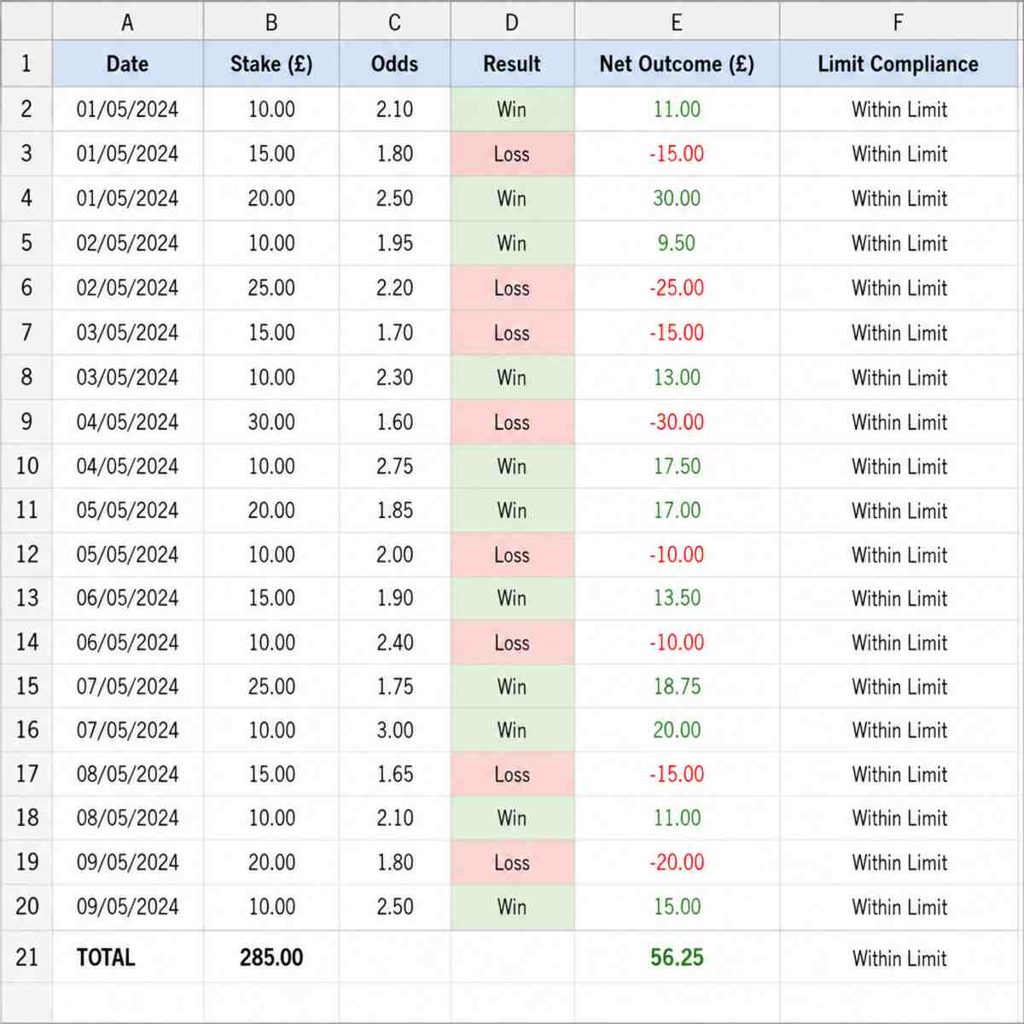
Use a simple spreadsheet or notebook rather than relying on memorable wins. Record every wager, including small losses, voids, and promotional activity. Make the entry before the event where possible, then add the result without rewriting your original reasoning.
A practical record can include:
| Field | What to record |
|---|---|
| Date and event | Enough detail to identify the wager |
| Selection and rules | The exact market and relevant settlement conditions |
| Stake and odds | The amount risked and the accepted price |
| Reasoning | Evidence, assumptions, and unresolved questions |
| Result | Win, loss, void, or other actual settlement |
| Financial outcome | Return minus stake and any applicable costs |
| Limit compliance | Whether you followed your money and time boundaries |
Separate account transfers from gambling results. Depositing money is not itself a betting loss, and withdrawing money is not itself a new betting win. Your record should show both the movement of money and the outcome of wagers without counting either twice.
Review profit separately from win rate
A hypothetical record shows why win rate alone is incomplete. Suppose you place ten $10 bets at decimal odds of 1.50, winning six and losing four. The six wins produce $30 in profit, while the four losses cost $40, leaving a net loss of $10 before any other costs.
In that example, winning most bets did not produce an overall profit. Record net results instead of using a successful-pick percentage as your main summary. Keep stakes visible too, so a larger loss does not disappear behind a count of smaller wins.
Review process questions alongside the numbers. Note whether you checked the rules, used current information, respected limits, and avoided unplanned deposits. A winning wager that broke your boundaries should not become the model for your next session.
Do not use the record to set a recovery target. Its purpose is to make your activity visible, including whether you want to stop. If reviewing it leaves you focused on “getting even,” put the analysis aside and take that reaction seriously.
Use a short decision checklist
A checklist is most useful when it can stop a decision, not just document one. Keep it short enough to read before every wager. If an item fails, leave the wager unplaced rather than inventing an exception.
Use this sequence:
- Verify eligibility and the operator. Confirm that you can legally use the exact service and understand who operates it.
- Check your existing exposure. Include unsettled wagers and the amount already spent during your chosen period.
- Read the selection precisely. Confirm the event, market, price, stake, and settlement rules.
- Write the evidence. Separate confirmed facts from assumptions and include a reason to reject the bet.
- Calculate the possible outcomes. Distinguish the total return, profit, and amount you could lose.
- Check your limits again. Do not let research effort or a promotion justify changing them.
- Record the decision. Include a decision not to bet when your checks are incomplete.
Protect any account you choose to use with a unique password and multifactor authentication where available. CISA recommends strong, unique passwords, password managers, and MFA as basic online protections. These measures protect access; they do not establish that a betting operator is trustworthy.
Recognize when to stop
Stop immediately when you reach a predetermined limit. Also pause if gambling starts to affect sleep, work, relationships, or essential spending. Chasing losses, borrowing to gamble, and needing larger amounts are among the warning signs described by the NHS.
Do not respond to those signs by searching for a more advanced betting strategy. Change the activity instead: close the session, tell someone you trust, and consider practical barriers. The NHS identifies self-exclusion, gambling-blocking software, and bank gambling-payment blocks as possible sources of support and protection.
Use whatever account limits or exclusion tools are genuinely available and suitable for your situation. Do not assume Bet404 provides a particular tool without checking. If support information is difficult to find, seek independent help rather than waiting for an operator to identify the problem.
In the United States, call or text 1-800-MY-RESET, the National Problem Gambling Helpline operated by the National Council on Problem Gambling. It connects people with local resources across all 50 states and U.S. territories. Outside the United States, contact an established gambling-support service or healthcare provider in your location.
Focus on informed decisions rather than guaranteed wins
The most useful Bet404 strategy is a clear decision process: verify the operator, understand the wager, calculate the return, acknowledge uncertainty, and respect your limits. Use research to challenge a selection, not simply to justify placing it. Keep complete records and allow your checklist to end with no bet.
None of these habits guarantees a winning outcome. They help make your choices more deliberate and easier to review. If gambling stops being affordable entertainment, stopping is the appropriate next step—not increasing the stake or searching for a recovery system.
