


How to Play the Card Game Spoons
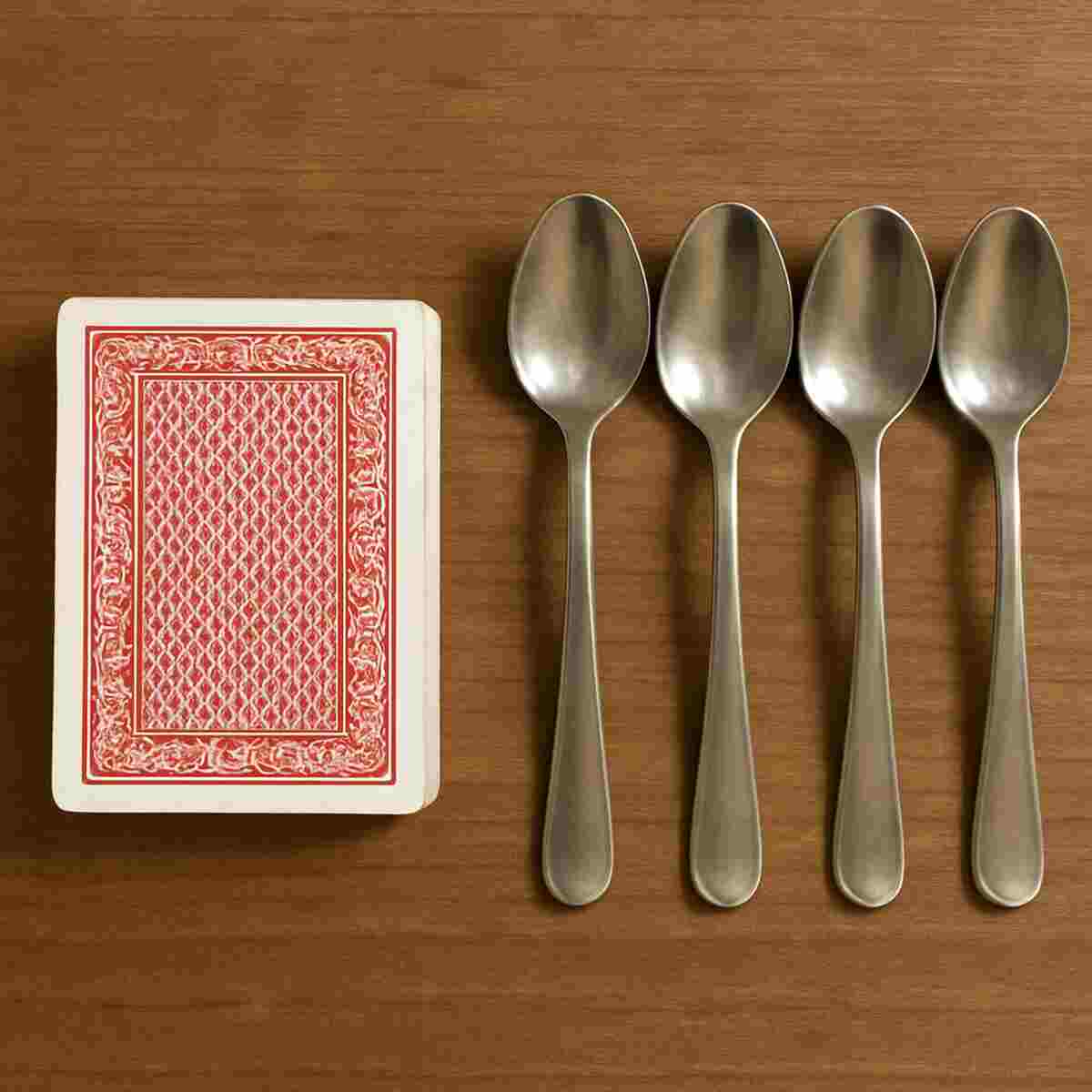
Looking for a game that’s easy to learn, guaranteed to cause laughter, and perfect for almost any group? Meet Spoons. It’s a fast-paced family card game where the real action happens in a flash, requiring nothing more than a standard deck of cards and a few spoons from your kitchen drawer. Check out cadetv.com to know more
The premise is brilliantly simple: players pass cards around a circle, each trying to secretly collect a set of four matching cards. As everyone focuses on their own hand, the tension quietly builds with every card that slides across the table. What starts as a calm exchange can erupt into chaos in a single heartbeat.
Suddenly, you see it—your friend subtly snatches a spoon from the center. This single action triggers a hilarious, free-for-all grab for the remaining spoons. In practice, the moment plays out like a game of musical chairs for your hands, making Spoons a fun icebreaker where the player left empty-handed is out for the round.
This guide will walk you through the simple setup, gameplay, and winning conditions, ensuring you’re ready to deal the first hand in just a few minutes.
What You Need to Play the Spoons Game (And What to Use If You Don’t Have Spoons)
You only need a few common household items to start playing Spoons. The game works best with a bit of a crowd, making it a perfect choice for family nights or parties. Before you deal the cards, make sure you have everything on this list.
- Players: 3 or more people. While it works with a small group, the chaos really shines with 5 to 8 players.
- Cards: One standard 52-card deck.
- Spoons: Or another easy-to-grab object.
The most important part of setting up is counting out the objects. You need exactly one fewer spoon than the number of people playing. So, if you have six players, you’ll place five spoons in the middle of the table. No spoons? No problem. You can substitute almost anything—bottle caps, coins, pieces of candy, or even car keys work great in a pinch.
Once you have your items gathered, you’re ready to learn the objective.
What Is the Main Goal of the Spoons Card Game?
The objective of Spoons is a two-part mission that starts with stealth and ends in a scramble. Your first goal is to collect a four-of-a-kind in your hand. This simply means getting four cards of the same rank—for example, four 7s or four Jacks.
Achieving that set, however, is just the trigger for the real fun. As soon as you have your four cards, your next objective is to grab a spoon. The moment you take one, every other player must race to grab one, too. The ultimate goal is to not be the player left empty-handed at the end of the round.
Setting Up the Game: A Quick 2-Step Guide
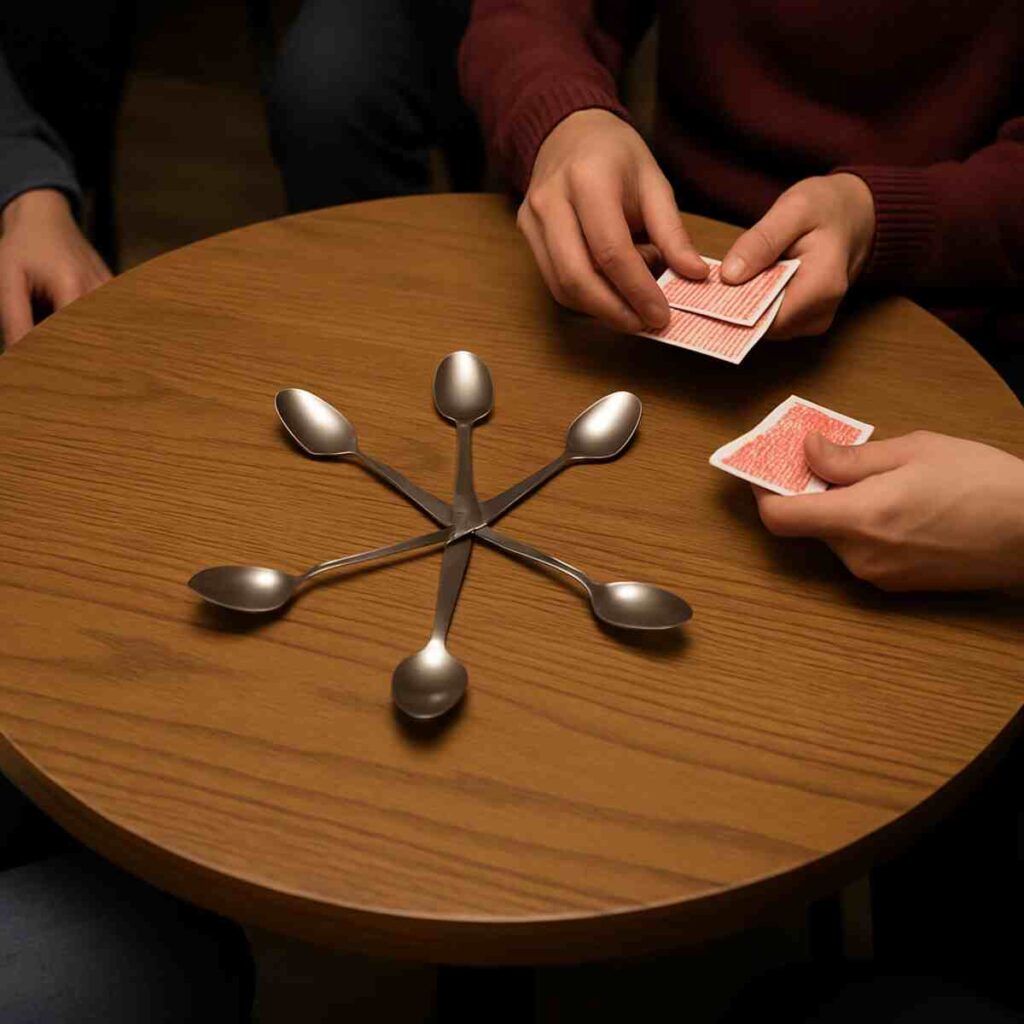
Getting started is as easy as grabbing items from your kitchen drawer. First, place the spoons in the center of the table where everyone can reach them. This setup is the key to the game’s frantic finish, ensuring one person will always be left empty-handed.
Next, you’ll prepare the cards. Instead of using the whole deck, you only need one set of four-of-a-kind for each person playing. For a five-player game, for instance, you could pull out all the 2s, 3s, 4s, 5s, and 6s from the deck, creating a smaller 20-card deck. Any ranks will do, just be sure you have one complete set for every player at the table.
With the spoons and cards ready, it’s time to deal. Shuffle your custom-made deck and deal exactly four cards to each person. One player will be the dealer, and they are the one who will kick off the action.
The Core Gameplay: How to Pass and Play
Forget taking turns—in Spoons, everyone plays at once in a continuous, fast-paced loop. The dealer officially kicks things off, but once the first card is passed, the action becomes a free-for-all. The entire game is about making quick decisions to build your hand while keeping an eye on your opponents.
The flow of cards moves in a circle, and the dealer’s job is to keep things moving by drawing from the leftover deck. Here’s how the action unfolds around the table:
- The dealer takes one card from the top of the deck to temporarily have five cards.
- They quickly decide which card they don’t want and pass it face-down to the player on their left.
- As soon as you receive a card from the player on your right, pick it up.
- Instantly look at your new hand and pass one unwanted card to the player on your left.
- This continues in a rapid circle, with cards constantly moving from player to player.
As you pass cards, you’re trying to get rid of cards you don’t need and hold onto the ones that help you build your set. If you start with two Kings, you’ll discard any other card that comes your way, hoping someone passes you another King. But what happens when you finally get that fourth King? That’s when you make your move.
The Big Moment: How to Grab a Spoon and Start the Chaos
That moment you get your fourth matching card is your signal to act. As soon as you complete your set, you have earned the right to secretly—or not-so-secretly—reach for one of the spoons in the middle of the table. You are the one who triggers the end of the round.
How you grab the spoon is entirely up to you and a huge part of the fun. You could casually continue passing cards for a second while slyly sliding a spoon toward you, hoping no one notices right away. Or, you can lunge for one dramatically, creating a sudden panic that sends everyone else scrambling. The choice between stealth and shock is yours to make.
This is the most important rule for every other player: the instant you see another player take a spoon, the game of passing cards is over. Your only job is to abandon your hand and immediately grab a spoon yourself.
The result is a hilarious, chaotic flash of hands diving for the center of the table. Whether you were the one who got a four-of-a-kind or you just noticed your friend’s sneaky move, the goal becomes the same for everyone: end the round with a spoon in your hand. But in this frantic grab, one player is always left behind.
What Happens When You’re Left Without a Spoon?
So, you lunged for a spoon but came up empty-handed. Don’t worry—in most games of Spoons, you aren’t immediately out! Instead, this is where the game’s simple and forgiving elimination system comes into play. The player who fails to grab a spoon is assigned the first letter in the word “Spoons”: an “S”. Think of it as a friendly warning shot.
With that first letter on your record, you are still in the game for the next round. If you miss grabbing a spoon again in a future round, you’ll collect the next letter, “P”, and so on. This continues until one unlucky player has collected all six letters to spell S-P-O-O-N-S. Only then is that player officially eliminated from the game, which keeps the fun going for as many people as possible.
After a player is assigned a letter, the game quickly resets for the next round. To prepare, you simply remove one spoon from the center pile. The remaining players gather the cards, shuffle, and deal again to start the fast-paced passing all over again.
How to Officially Win the Game of Spoons
Winning a single round feels great, but the ultimate prize in Spoons is being the last person left at the table. The objective is pure survival. As other players slowly collect letters and are eliminated one by one, the game gets more intense. Your real goal isn’t just to be quick in one round; it’s to outlast everyone else. The official champion is the one player who successfully avoids spelling out S-P-O-O-N-S through every round.
Eventually, the game boils down to just two competitors. This triggers the final, high-stakes showdown: two players, four cards each, and only a single spoon sitting in the middle. The winner of this head-to-head round is crowned the champion, earning ultimate bragging rights.
3 Simple “Strategies” to Help You Win Spoons
Spoons might seem like it’s all about luck and fast hands, but a little bit of smart observation can give you a serious edge. The best strategy isn’t about memorizing cards; it’s about paying attention to the people you’re playing with. Instead of burying your head in your own hand, keep your eyes up and scanning the table. The moment a player gets four of a kind, their behavior will change—a slight hesitation, a quick glance at the spoons, or a sudden grin they try to hide. Catching these tells gives you a head start before the grab even happens.
Another key tactic is to always be physically ready. Many players lose because their grabbing hand is busy holding cards or resting in their lap. To improve your reaction time, decide which hand will be your “passing hand” and which will be your “grabbing hand.” Keep that grabbing hand free and hovering near the center of the table at all times. Those milliseconds you save can be the difference between staying in and getting a letter.
Finally, increase your own speed and mental focus by deciding what to discard before you even pick up the next card. As soon as you receive a card from the player on your right, you should already know which one in your hand is the least valuable. Immediately pass that pre-selected card to your left. This makes you a faster player, which puts pressure on others and frees up your brainpower to watch for tells.
How to Make the Game More Challenging: 3 Fun Variations
If the classic version of Spoons is starting to feel a little too predictable, you can easily raise the stakes with a few fun variations. These simple changes add a new layer of difficulty without overcomplicating the rules. Try one of these twists during your next game night:
- Silent Spoons: No talking, laughing, or sound effects allowed! This forces everyone to rely solely on their eyes, making the stealthy spoon grab even more intense. When someone finally breaks the silence by snatching an object, the resulting explosion of action is hilarious.
- Alternative Objects: Swap the spoons for something harder to grab, like poker chips or coins. They’re much harder to pick up in a hurry!
- Toe Spoons: For the truly daring, play with your feet. Exactly as it sounds, you place the spoons on the floor and must use only your feet to grab one. It’s chaotic, ridiculous, and completely changes the game.
These twists ensure the game stays fresh and can be tailored to your group’s sense of humor and adventure.
How to Play Spoons with a Large Group (8+ Players)
The frantic fun of Spoons is contagious, so it’s no surprise when everyone wants to join in. The game is fantastic for large groups with just a couple of small tweaks. The main adjustment is adding more cards to the mix. A good rule of thumb is to shuffle a second standard deck into play once you reach nine or more players. This ensures there are enough potential four-of-a-kind sets to go around.
When setting up for a crowd, your primary goal is fairness. If your table is too small for everyone to comfortably reach the middle, don’t be afraid to move to the floor. Have everyone sit in a large circle and place the spoons in a cluster right in the center. This gives each player a more or less equal shot at grabbing one when the action starts.
Beyond those logistical changes, the rules remain exactly the same. The goal is still to collect your set and be quick enough to snag a spoon—you’re just expanding the chaos with more players.
Spoons vs. Pig: What’s the Difference?
If you enjoy the hawk-eyed watchfulness of Spoons, you’ll feel right at home with Pig. At its heart, the goal is exactly the same: be the first player to collect four cards of the same rank. The fast-paced passing of cards and the desperate search for that final matching card are identical in both games.
The big difference is what you do when you get your set. Instead of grabbing a spoon, the player secretly and quietly touches their finger to their nose. The moment another player spots this, they must also touch their nose. A silent chain reaction begins until one person is left, unaware, as the last one to react.
Rather than being knocked out after one loss, the player who was last to touch their nose gets a letter. In the first round they lose, they get a “P,” the second time an “I,” and the third time a “G.” Spelling “PIG” means you’re out of the game for good. The penalty is different and there’s no clatter of plastic, but the panic of realizing you’re last is just as fun.
Ready for a Mad Dash? Here’s Your Quick-Start Plan
A few minutes ago, “Spoons” might have just been a utensil in your kitchen drawer. Now, you have the power to turn a quiet evening into a burst of chaotic energy. You’re officially ready to lead the game.
Here’s your three-step launch plan:
- Grab a deck, spoons, and 3+ friends.
- Deal four cards each and place the spoons in the middle.
- Start passing and watch for the grab!
Forget what you know about quiet, strategic card games. The real goal in Spoons is shared fun. The victory isn’t who is left holding a spoon—it’s the hilarious, table-shaking moment when everyone dives for them at once. Now go start some happy chaos.
